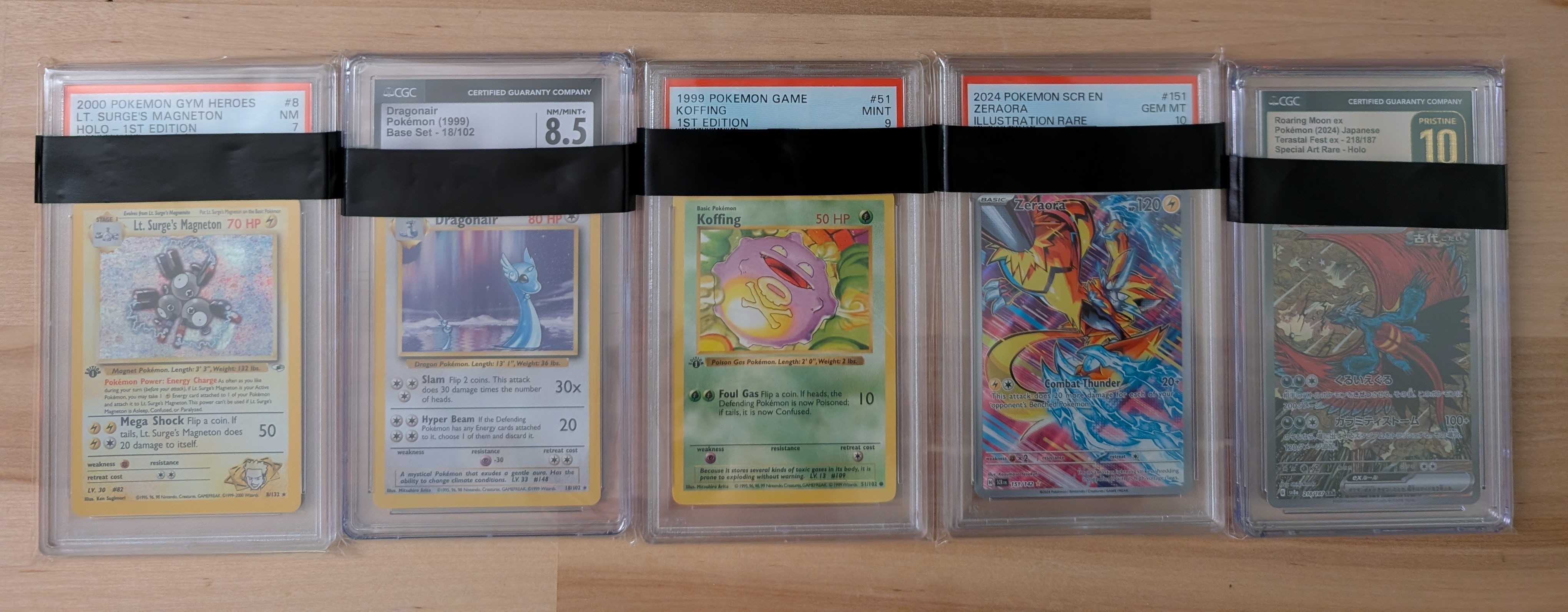
If you collect Pokémon cards, the difference between "mint" and "Gem Mint" can matter a lot. PSA grades trading cards on a 1-to-10 scale, but the number is not based on a single defect or a simple checklist. Graders evaluate the entire card, including centering, corners, edges, surface, print quality and overall eye appeal.
This guide translates PSA's published grading standards into a practical reference for Pokémon collectors. The grade definitions below are based on PSA's official standards rather than an unofficial community scale.
PSA grades each card individually. This guide can help you understand the standards, but photographs or a home inspection cannot guarantee the grade PSA will assign.
PSA 10: Gem Mint
PSA 10 is PSA's Gem Mint grade. PSA describes a 10 as a virtually perfect card with four sharp corners, sharp focus and full original gloss.
One of the most useful published numbers for collectors is PSA's centering tolerance. For a PSA 10, the image should be centered approximately:
- 55/45 or better on the front
- 75/25 or better on the back
PSA notes that a slight printing imperfection may be allowed if it does not hurt the card's overall appeal, and its centering note allows graders some discretion for small variances based on eye appeal.
This is important because a PSA 10 does not necessarily require mathematically perfect 50/50 centering. It does, however, require an exceptionally clean card overall.
PSA 9: Mint
A PSA 9 is a superb-condition card with only one of the minor flaws PSA permits at this level. Examples in PSA's standard include a very slight wax stain on the reverse, a minor printing imperfection or slightly off-white borders.
PSA's published centering guideline for a 9 is approximately 60/40 or better on the front and 90/10 or better on the reverse.
For modern Pokémon cards, the practical distinction between a 9 and a 10 can be frustrating because a flaw may be small. A card can look excellent in a normal photograph and still contain a minor surface, corner, edge or centering issue that keeps it out of Gem Mint territory.
PSA 8: Near Mint-Mint
A PSA 8 can initially look similar to a PSA 9, but closer inspection may reveal a slight issue. PSA's standards allow characteristics such as very slight fraying at one or two corners, a minor printing imperfection, slight wax staining on the reverse or very slight off-white borders.
PSA lists approximate centering of 65/35 or better on the front and 90/10 or better on the reverse for an 8.
For collectors pre-grading modern Pokémon cards, this is a useful reminder that small defects can accumulate. A card does not have to be heavily damaged to fall several points below a 10.
PSA 7: Near Mint
At PSA 7, PSA allows slight surface wear visible on close inspection. Some corners may show slight fraying, and a minor printing blemish is acceptable. Slight wax staining on the back can also be acceptable, while most original gloss should remain.
PSA's published centering guideline is approximately 70/30 to 75/25 or better on the front and 90/10 or better on the back.
A PSA 7 can still be an attractive card. This becomes especially important with vintage Pokémon, where age, rarity and value can make grading worthwhile even when Gem Mint is unrealistic.
PSA 6: Excellent-Mint
A PSA 6 may have visible surface wear or a printing defect that does not destroy its overall appeal. PSA also allows a very light scratch that can be detected only upon close inspection, along with slightly graduated corner fraying.
The card can show some loss of original gloss, minor wax staining on the reverse and some notching on edges.
At this point, defects are generally easier to identify during a careful pre-grade than the tiny imperfections separating many high-grade cards.
PSA 5: Excellent
A PSA 5 can have minor rounding of the corners and more noticeable surface wear or printing defects. PSA says original gloss may begin to break down, and light scratches that do not detract from the card's appeal may be visible.
Edges may show minor chipping, and the card may have some off-white borders.
A PSA 5 is far from a destroyed card. On rare vintage Pokémon cards, a mid-grade example can still be desirable because condition is only one part of collectibility.
PSA 4: Very Good-Excellent
A PSA 4 can show slightly rounded corners and noticeable surface wear. PSA allows light scuffing or scratches and some loss of original gloss. Borders may be off-white, and a light crease may be visible.
This is where condition issues become substantially easier to see without magnification.
PSA 3: Very Good
A PSA 3 shows more obvious wear. PSA's standard allows rounded corners, considerable discoloration or yellowing, visible surface wear, printing defects and scratches. A crease may be visible, and centering can be significantly off.
Despite the wear, the card must still retain enough overall presentation to meet the grade rather than falling to the lower levels.
PSA 2: Good
A PSA 2 can have accelerated corner rounding and obvious surface wear. PSA allows scratching, scuffing, light staining, chipping on the front and several creases. Original gloss may be nearly gone.
A card at this level is clearly well-worn, but for scarce or historically important cards, authentication and encapsulation can still be useful.
PSA 1: Poor
PSA 1 is the lowest numerical grade. PSA describes cards at this level as having defects that may include major creasing, extreme discoloration, dirtiness, warping and other severe wear. A card may even be missing small pieces.
PSA 1 does not mean "worthless." A rare card can remain collectible in very low grade, and some collectors intentionally pursue complete low-grade sets or authentic examples of cards that are prohibitively expensive in higher condition.
Quick PSA Grade Reference
| PSA Grade | Name | General Condition |
|---|---|---|
| 10 | Gem Mint | Virtually perfect |
| 9 | Mint | Superb condition with one minor flaw |
| 8 | Near Mint-Mint | High-end card with a slight defect |
| 7 | Near Mint | Attractive card with minor wear |
| 6 | Excellent-Mint | Visible but relatively minor wear |
| 5 | Excellent | Moderate wear becoming apparent |
| 4 | Very Good-Excellent | Noticeable wear and possible light crease |
| 3 | Very Good | Significant visible wear |
| 2 | Good | Heavy wear, possibly several creases |
| 1 | Poor | Severe wear or damage |
These descriptions are summaries. PSA's complete official standards contain considerably more detail and should be the final reference when evaluating a submission.
What Does PSA Actually Look At?
For Pokémon cards, it is useful to organize your inspection into four familiar areas:
Centering
Compare the borders and printed design from side to side and top to bottom. PSA publishes centering tolerances for its grades, but also states that overall eye appeal can affect judgment near a boundary.
Corners
Look for whitening, fraying, rounding, dings and compression. Check the back as carefully as the front.
Edges
Look for whitening, chipping, notching and wear along all four sides.
Surface
Look for scratches, scuffs, print defects, stains, loss of gloss, dents, wrinkles and creases. Angled lighting is particularly helpful because some surface defects disappear when viewed straight on.
These areas interact. There is no official rule saying, for example, that one tiny white corner automatically equals one particular grade.
Why Two Similar-Looking Cards Can Grade Differently
PSA explicitly acknowledges that grading is not entirely mechanical. Many characteristics can be observed objectively, but eye appeal and grader judgment can matter when a card falls near the boundary between grades.
That is one reason it is risky to promise a grade from online photographs. A photograph may hide a fine scratch, shallow dent, loss of gloss or another defect that becomes visible when the physical card is moved under light.
What Does "No Grade" Mean?
Not every card submitted to PSA receives a number from 1 through 10.
PSA publishes several no-grade designations. Reasons can include:
- Evidence of trimming
- Evidence of restoration
- Recoloration
- Questionable authenticity
- Altered stock
- Failure to meet minimum size requirements
- Evidence of cleaning
- Certain miscuts
- Items PSA does not grade or cannot encapsulate
This is another reason not to clean, trim, recolor or otherwise attempt to repair a card before grading. Alteration can create a much larger problem than the original cosmetic defect.
Does a Pokémon Card Need a PSA 10 to Be Worth Grading?
No. PSA itself notes that vintage cards can remain valuable even in lower grades and that rarity, scarcity and sentimental value can make cards worth grading regardless of condition.
The sensible question is not simply "Will this get a 10?" Instead ask:
1. What card is it?
2. What condition is it realistically in?
3. Why do I want it graded — resale, authentication, protection, collection display or sentimental value?
4. Does the expected benefit justify the grading and shipping cost?
A modern card with plentiful supply may depend heavily on achieving a high grade for financial upside. A rare vintage Pokémon card can be a completely different calculation.
PSA 10 vs. PSA 9: The Key Takeaway
Collectors often obsess over the difference between a 9 and a 10 because both can look extremely clean.
The official standards make the distinction clearer: a 10 is expected to be virtually perfect, while a 9 can contain one minor flaw. Centering tolerances are also tighter at PSA 10.
That means "pack fresh" and "looks perfect to me" are not grading standards. If you are considering a submission, inspect the card systematically under good light before deciding what grade you expect.
For a step-by-step inspection process, see our Pokémon card pre-grading checklist.