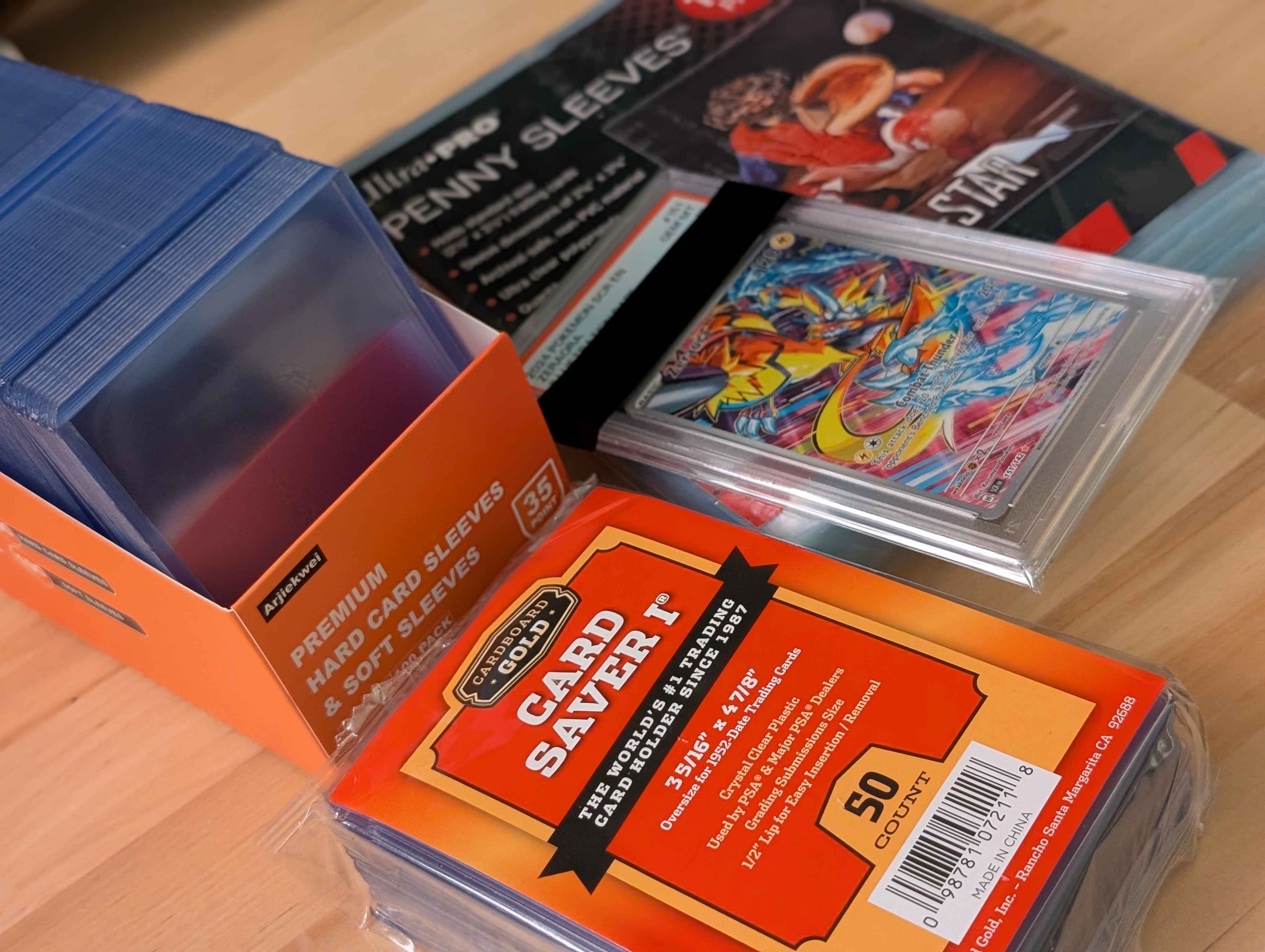
Good storage is less about buying the most expensive accessory and more about preventing the ordinary damage that happens when cards are handled, transported and displayed. Scratches, fingerprints, bent corners and damaged sleeves are all easier to prevent than fix.
Here is a straightforward storage setup for raw cards, binder collections, cards headed to grading and already-graded cards.
Start With a Card Sleeve
For cards you want to keep in good condition, a sleeve creates a basic barrier between the card surface and whatever holds it next.
Pokemon itself routinely includes card sleeves in products intended for players and collectors. Its Trainer's Toolkit, for example, includes 65 card sleeves, and Pokemon's official League guidance recommends carrying a sleeved deck in a deck box so cards and sleeves remain protected between matches.
For collectible raw cards, choose a clean sleeve sized for standard trading cards. PSA's own card-sleeve products describe archival-grade, acid-free, non-PVC polypropylene sleeves designed for standard 2.5-by-3.5-inch cards and intended to protect collectibles from scratches.
Binder Storage Works Well for Collections
Binders make it easy to organize a set and see cards without repeatedly removing them. Pokemon sells official binder collections for exactly this purpose; its Scarlet & Violet—Prismatic Evolutions Binder Collection uses a 9-pocket binder capable of holding up to 378 cards.
For cards you care about preserving, sleeve the card before putting it into the binder pocket when the pocket comfortably accommodates the sleeved card. Avoid forcing cards into pockets that are too tight.
A binder is particularly useful when your goal is set collecting, displaying favorite cards or keeping a large number of cards organized and accessible.
What About Toploaders?
A rigid toploader adds more structural protection than a soft sleeve alone and can be useful when storing or transporting individual raw cards. The important part is that the card should not be loose against hard plastic where its surface can be scratched during insertion or removal; sleeve it first.
Toploaders are not, however, PSA's current preferred holder for grading submissions. PSA's shipping guide tells submitters to place each card in a clear penny sleeve and then into a semi-rigid holder. PSA specifically says not to submit standard cards in toploaders.
If grading is the destination, follow the grader's current instructions rather than assuming your normal storage setup is also the correct submission setup. See our step-by-step PSA packing guide for the full process.
When to Use a Semi-Rigid Holder
Semi-rigid holders are especially useful for cards being prepared for grading. PSA currently requires standard trading cards to be sleeved and inserted into appropriately sized semi-rigid holders for submission.
PSA describes semi-rigid holders as thin but sturdy protection that provides added structural integrity during storage and shipping. Its Card Saver 1 holders are also officially used by PSA and dealers.
For a card you are considering grading, first inspect it carefully using our Pokemon card pre-grading checklist, then sleeve it and move it into the holder required by your grading service.
Protecting Graded Pokemon Cards
A grading slab protects the card itself, but the slab can still collect fingerprints, dust and scratches.
PSA sells precision-fit sleeves specifically for PSA-graded cards and says they are designed to guard slabs against dust, fingerprints and scratches. PSA also offers dedicated graded-card storage cases for larger collections.
You do not need to put every slab into an elaborate case. A simple slab sleeve can help keep the holder clean, while a dedicated storage box or case can keep multiple graded cards organized and reduce unnecessary handling.
A Simple Storage Setup by Card Type
| Card type | Practical protection |
|---|---|
| Playable deck | Card sleeves + deck box |
| Binder collection | Card sleeve + binder pocket |
| Individual collectible | Card sleeve + suitable rigid or semi-rigid holder |
| Card being sent to PSA | Clear penny sleeve + PSA-specified semi-rigid holder |
| PSA-graded card | Slab + optional fitted slab sleeve/storage case |
There is no need to make card storage complicated. Match the protection to what you actually do with the card.
Avoid Unnecessary Handling
Every time a raw card is removed and reinserted, there is another opportunity to catch a corner, touch the surface or introduce debris into the sleeve.
If a card is already safely stored, leave it alone unless you have a reason to move it. When handling a raw card, use clean, dry hands and avoid touching the front or back surface when practical.
If you are preparing a valuable card for professional grading, inspect it before final storage so you do not need to repeatedly remove it. Our guide to the PSA grading scale for Pokemon cards explains the condition characteristics PSA evaluates.
Bottom Line
For most Pokemon collections, the basic hierarchy is simple: sleeve first, then add the level of structural protection appropriate to the card.
Use binders for organized collections, rigid holders when individual raw cards need additional protection, and the grading company's specified semi-rigid holders when submitting cards. Once a card is graded, protecting the slab itself from scratches and fingerprints can keep the entire collectible looking better.
Always check a grading company's current submission instructions before mailing cards because holder and packing requirements can change.